Understanding landlord electrical certificate UK requirements is essential for anyone renting out a property in London, Barnet or anywhere across the UK. Electrical safety rules protect tenants, reduce fire and shock risks, and help landlords prove that their property has been checked by a competent person. If you manage a rental home locally, working with professional Electrical Services in Barnet can make the process clearer, from inspection planning to report explanation. For landlords who need organised compliance support, Trusted Landlord Electrical Certification in Barnet can help you arrange the right electrical inspection at the right time.
A landlord electrical certificate usually refers to an Electrical Installation Condition Report, commonly known as an EICR. The report records the condition of the fixed electrical installation in a rented property. This includes wiring, socket-outlets, light fittings, consumer units, protective devices, earthing and bonding. It is not simply a formality; it is a safety document that shows whether the installation is satisfactory for continued use.
The requirements can differ slightly between England, Wales, Scotland and Northern Ireland, so landlords should always follow the rules that apply to the location of their property. However, the main principle is consistent: rental properties need regular electrical inspection and testing, and landlords must act when a report identifies danger, potential danger or the need for further investigation.
Landlord Electrical Certificate UK Requirements Infographic
This visual guide summarises the key EICR compliance points for UK landlords, including inspection timing, report duties, EICR codes, remedial work and practical booking preparation.
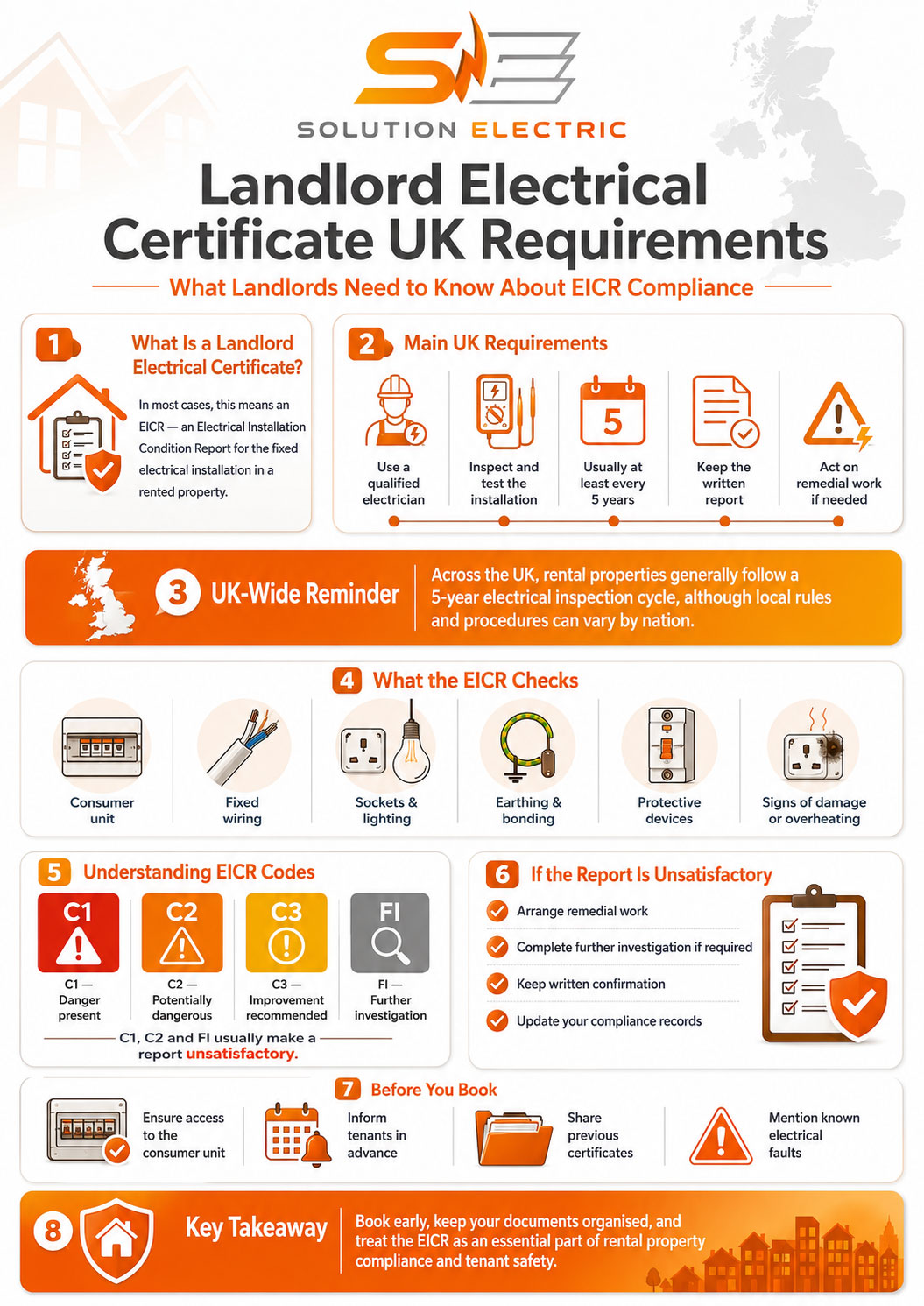 Click the infographic to view larger
What Is a Landlord Electrical Certificate?
A landlord electrical certificate is the common name many landlords use when talking about the paperwork needed after an electrical safety inspection. In most rental property situations, the key document is an Electrical Installation Condition Report. This report confirms whether the fixed electrical installation is safe for continued use or whether repairs, improvements or further investigation are required.
The EICR is completed by a qualified and competent electrician or electrical inspector. It is based on inspection and testing of the electrical installation, not just a quick visual check. The electrician may test circuits, check protective devices, inspect the consumer unit, review earthing and bonding, and identify signs of damage, wear, unsafe alterations or overloaded circuits.
For landlords, the certificate helps demonstrate that they have taken electrical safety seriously. It also gives a clear written record for tenants, letting agents and local authorities. If the result is satisfactory, the landlord can keep the report for future reference. If the result is unsatisfactory, the report becomes the starting point for remedial action.
- Usually refers to an Electrical Installation Condition Report
- Covers fixed wiring and electrical installations
- Completed by a qualified and competent person
- Confirms whether the installation is satisfactory
- Records observations and safety codes
- Helps landlords manage legal compliance
Main Landlord Electrical Certificate UK Requirements
The core UK requirement is that landlords must keep electrical installations in rental homes safe. In practical terms, this normally means arranging periodic inspection and testing, obtaining a formal report, keeping a copy, giving the report to tenants where required, and completing any necessary remedial or investigative work.
In England, the inspection and testing interval is at least every five years, unless the previous report states that the next inspection must happen sooner. Similar five-year inspection principles apply in other parts of the UK, but the exact rules, terminology and paperwork deadlines can vary by nation.
Landlords should not wait until a tenant complains or a letting agent asks for evidence. A valid electrical report should be treated as part of the property’s core compliance file, alongside gas safety records, fire safety checks, smoke alarm duties, EPC information and tenancy documentation.
- Arrange inspection and testing at required intervals
- Use a qualified and competent electrician
- Obtain a written electrical safety report
- Give the report to tenants where required
- Keep records for future inspections
- Complete remedial work if the report is unsatisfactory
Electrical Certificate Requirements for Landlords in England
For rental properties in England, landlords must ensure the electrical installation is inspected and tested by a qualified person at least every five years. The landlord must obtain a report, usually an EICR, which gives the results of the inspection and sets the date for the next inspection and test.
The landlord must provide a copy of the report to the existing tenant within the required timeframe, provide it to a new tenant before occupation, and supply it to the local council if requested. This makes the EICR both a safety document and an important compliance record.
If the report identifies remedial work or further investigation, the landlord must arrange for the required work to be completed within the required period. A shorter deadline may apply if the report specifies urgent action. Once remedial work is completed, written confirmation should be kept and provided where required.
This is why landlords should avoid leaving EICR bookings until the last moment. If an inspection finds C1, C2 or FI observations, time may be needed to arrange repairs, re-testing and documentation before the property can be treated as compliant.
UK Landlord Electrical Safety Requirements by Nation
Although landlords often search for “UK requirements”, electrical safety rules are not identical everywhere. The table below gives a practical overview of the general position across the UK. It is useful for landlords with properties in more than one area, but local legal advice or official guidance should be checked where there is any uncertainty.
| Location |
General Requirement |
Key Landlord Action |
| England |
Electrical installation inspection and testing at least every 5 years, unless the report states a shorter period. |
Obtain EICR, give copies to tenants where required, and complete remedial or investigative work. |
| Wales |
Periodic inspection and testing is required at least every 5 years, with valid electrical condition reporting for rented homes. |
Provide the required report to the contract-holder and act on any unsafe findings. |
| Scotland |
Private landlords should ensure EICR checks are completed every 5 years as part of the Repairing Standard. |
Keep inspection records and ensure the property remains electrically safe throughout the tenancy. |
| Northern Ireland |
Private tenancy electrical safety standards require inspection and testing by a qualified person at least every 5 years. |
Provide proof of electrical safety to tenants and the council if requested. |
| London and Barnet |
London landlords follow the England requirements for rental electrical safety. |
Plan EICR inspections before tenancy deadlines and keep documentation ready for agents, tenants or councils. |
The most important point is that landlords should not assume an old certificate is enough. Always check the inspection date, the next inspection date on the report, the report outcome and whether any recommendations or remedial actions remain unresolved.
What Does an EICR Inspection Check?
An EICR focuses on the fixed electrical installation. This means the wiring and electrical components that form part of the property, rather than portable appliances. The inspection can include the consumer unit, socket-outlets, light fittings, fixed equipment, circuits, protective devices, earthing and bonding arrangements.
The purpose is to identify whether the installation is safe for continued use. The electrician will look for signs of damage, deterioration, overheating, poor connections, overloaded circuits, lack of protection, missing earthing or bonding, and previous work that may not meet safety standards.
Power may need to be switched off during parts of the inspection and testing. Landlords should tell tenants in advance and make sure the electrician has access to all relevant rooms, cupboards, consumer units, outbuildings and electrical points.
- Consumer unit and protective devices
- Socket-outlets and light fittings
- Fixed wiring and electrical circuits
- Earthing and bonding arrangements
- Signs of damage or overheating
- Potential shock risks and fire hazards
Understanding EICR Codes: C1, C2, C3 and FI
The result of an EICR is not just “pass” or “fail”. The report uses classification codes to explain the seriousness of any observations. Understanding these codes helps landlords know what action is required and how urgent the work may be.
A C1 code means danger is present and immediate action is required. A C2 code means there is a potentially dangerous condition. FI means further investigation is required without delay because the inspector cannot confirm safety without more detailed checks. These codes normally make the report unsatisfactory.
A C3 code means improvement is recommended. It does not usually make the report unsatisfactory by itself, but it should still be taken seriously. C3 observations can help landlords improve long-term safety, modernise the installation and avoid future compliance problems.
- C1 means danger is present
- C2 means potentially dangerous
- C3 means improvement recommended
- FI means further investigation required
- C1, C2 and FI normally need action
- C3 should be reviewed as good practice
When Remedial Work Is Required
If an EICR is marked unsatisfactory, the landlord must act. The required action may be a repair, replacement, upgrade or further investigation. Examples might include damaged accessories, inadequate protective devices, poor earthing, exposed live parts, unsafe consumer unit issues, overheating signs or wiring that needs further investigation.
Remedial work should be carried out by a qualified person and properly documented. Depending on the nature of the work, the landlord may receive written confirmation, a Minor Electrical Installation Works Certificate, an Electrical Installation Certificate or a follow-up satisfactory report.
Landlords should keep copies of all reports and remedial documents together. This helps demonstrate that the original issue was not ignored and that the property was brought back into a safe condition.
What Must Landlords Provide to Tenants?
Documentation is a major part of landlord electrical safety compliance. A landlord should keep a copy of the electrical safety report and provide it to tenants within the required timeframe for the relevant nation. In England, a new tenant should receive the report before they occupy the property, and existing tenants must receive the report after inspection within the required period.
Landlords should also be ready to provide the report to the local authority if requested. If remedial work has been completed, written confirmation should also be retained and supplied where required. Letting agents often request these documents before marketing or renewing a tenancy.
Good record keeping reduces stress. It also helps if a tenant raises concerns, an agent requests compliance documents, or the local council asks for evidence.
- Copy of the current EICR report
- Previous reports where useful
- Written confirmation of remedial work
- Electrical certificates for completed works
- Access records and tenant communication
- Next inspection date reminder
How Landlords Can Prepare for an Electrical Inspection
Preparation helps the inspection run smoothly. Before the electrician arrives, landlords should make sure the consumer unit is accessible, tenants are informed, and all relevant rooms can be entered. Furniture or stored items should be moved away from important electrical points where possible.
If there have been previous electrical issues, tell the electrician. Examples include tripping circuits, flickering lights, damaged sockets, burning smells, buzzing sounds, overheating accessories or tenant reports of intermittent faults. These details can help the inspector understand the property’s history.
Landlords should also share any previous EICR reports, installation certificates, consumer unit upgrade documents or remedial records. This can make the inspection more efficient and gives useful background about the installation.
- Confirm access with tenants in advance
- Clear the area around the consumer unit
- Share previous electrical documents
- Mention known faults or tenant complaints
- Allow for possible power interruption
- Arrange parking or access information if needed
Final Compliance Tips for UK Landlords
Landlord electrical certificate requirements should be managed proactively, not only when a tenancy is about to start. Add the EICR expiry date to your compliance calendar, keep all documents in one folder and book inspections early enough to allow for possible remedial work.
Remember that the report is only useful if it is read and acted on. A satisfactory EICR should be stored safely. An unsatisfactory report should be followed by repairs, further investigation where required and written confirmation that the necessary work has been completed.
For landlords, homeowners and managing agents who need reliable local support, Landlord Certificates can help with inspection planning, EICR reporting and electrical safety documentation. If you also need wider repairs, testing or property electrical support, professional Electrical Services in Barnet can help keep your rental property safer, better documented and ready for tenancy requirements.
Need a Landlord Electrical Certificate?
Solution Electric provides landlord electrical certificates, EICR inspections, testing and electrical safety support for rental properties across Barnet and surrounding London areas.
Book your landlord electrical inspection with confidence.