If you are a landlord asking how often an EICR is required in the UK, the key point is that rented properties in England usually need the electrical installation inspected and tested at least every five years, unless the report states a shorter interval. For landlords in Barnet, arranging professional Electrical Services in Barnet helps keep inspections, reports and remedial work organised before a tenancy, during property management or when a certificate is approaching expiry. Solution Electric also supports rental property owners who need Trusted Landlord Electrical Certification in Barnet for flats, houses, HMOs and managed properties.
An Electrical Installation Condition Report, commonly called an EICR, is a formal inspection and test of the fixed electrical installation inside a property. It is not simply a visual check or a basic certificate. It assesses whether the electrical installation is safe for continued use, whether there are signs of danger, and whether further investigation or remedial work is needed.
For UK landlords, the question is not only how often an EICR is required, but also when to renew it, who should receive a copy, what happens after an unsatisfactory report and how records should be stored. This guide explains the practical EICR frequency rules for landlords, with a focus on safe, compliant and well-managed rental properties.
How Often Is an EICR Required for UK Landlords? Infographic
This visual guide summarises the main EICR timing rules, early inspection triggers, report sharing duties and record-keeping steps for rental property owners.
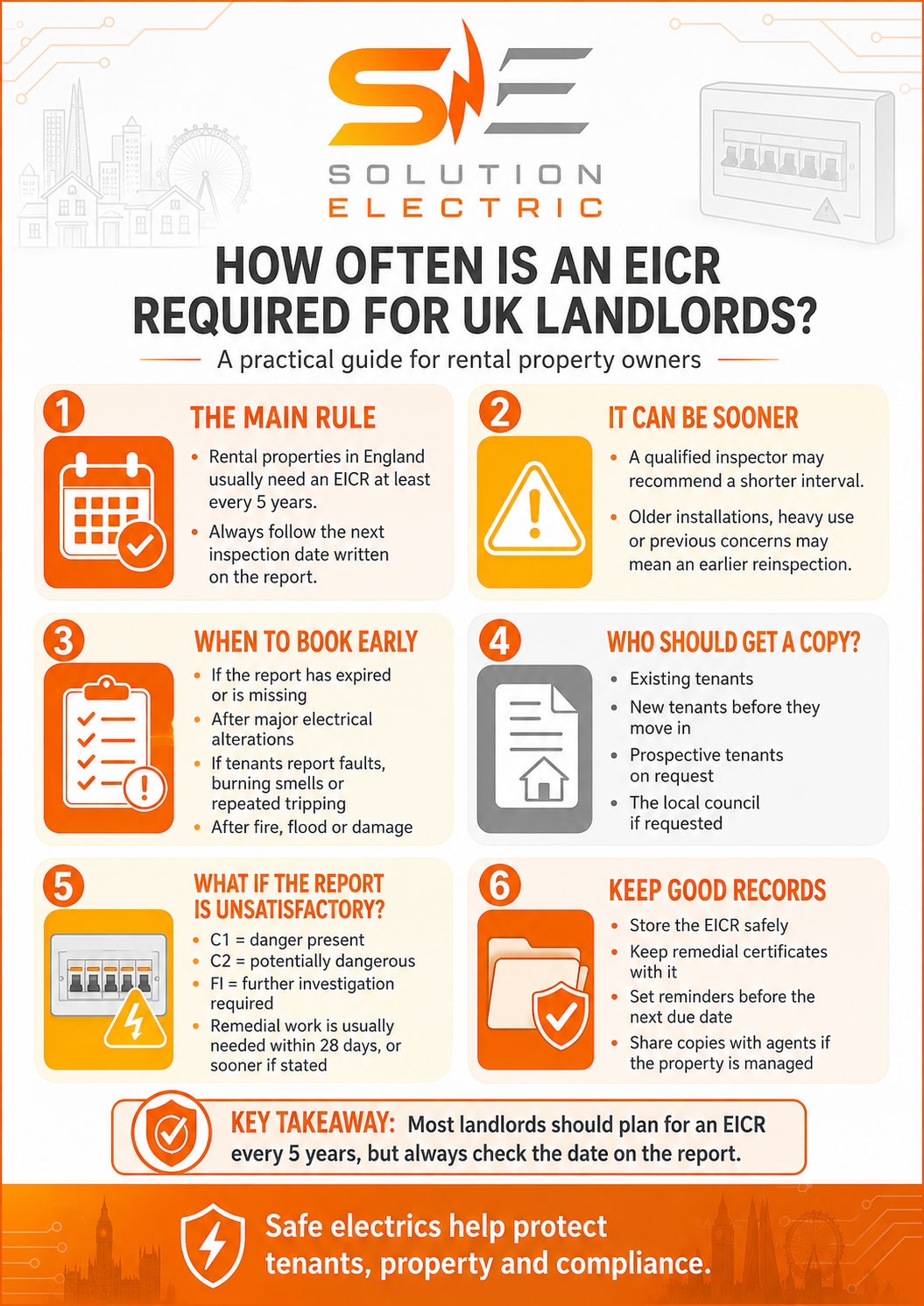 Click the infographic to enlarge
How Often Is an EICR Required for UK Landlords?
In England, landlords generally need to ensure that the electrical installation in a rented property is inspected and tested at least every five years by a qualified and competent person. The resulting report is usually an Electrical Installation Condition Report. If the report gives a shorter recommended interval, the landlord should follow that date rather than assuming that five years always applies.
This frequency matters because electrical installations can deteriorate with age, use, environmental conditions and previous alterations. A property may look clean and well maintained, but hidden wiring issues, loose connections, overloaded circuits or missing protective measures can still exist behind walls, inside consumer units or within older accessories.
For landlords, the EICR cycle should be treated as part of routine property management. It is sensible to check the report expiry date well before a new tenancy begins or before a letting agent requests evidence. Leaving the inspection until the last moment can cause delays if access is difficult or if remedial work is needed.
- Most rental properties need inspection at least every five years
- The report may recommend a shorter interval
- A qualified and competent person should carry out the test
- The report should be kept until the next inspection
- New tenants should receive the current report before occupation
- Remedial work should be arranged promptly when required
What Does the Five-Year EICR Rule Really Mean?
The five-year rule means that landlords should not allow the fixed electrical installation report to become outdated. However, the expiry date is not always exactly five years from the day of inspection in every situation. The inspector may recommend that the next inspection happens sooner if the installation is older, heavily used, shows signs of deterioration or has limitations that should be reviewed earlier.
The report should include the date of the inspection and the recommended date for the next inspection and test. Landlords should use that recommended date as the working deadline. If the report says the next inspection is due in three years, it would not be wise to wait five years simply because five years is often quoted as the general rule.
A good property management system should record the inspection date, next due date, report outcome and any remedial evidence. This is especially important for landlords with several properties, letting agents managing multiple tenancies or HMOs where electrical systems may be used more intensively.
When Might a Landlord Need an EICR Earlier Than Five Years?
An earlier EICR may be needed when the existing report has expired, cannot be found, is marked unsatisfactory, or no longer reflects the current condition of the property. Electrical work, renovations, flood damage, fire damage, repeated tripping or tenant complaints may all justify a fresh inspection or at least professional electrical investigation.
Landlords should also consider the timing of new tenancies. If a valid report already exists and it does not require remedial or investigative work, a new inspection is not normally required simply because a new tenant is moving in. However, the new tenant should still be given the most recent valid report before they occupy the property.
If the property has changed significantly since the last report, the landlord should not rely blindly on old paperwork. For example, a kitchen refurbishment, consumer unit replacement, extra sockets, bathroom electrical changes or landlord supply alterations may create a need for updated electrical certification or a new assessment.
- The report has expired or is missing
- The report recommends an earlier inspection date
- Electrical alterations have been carried out
- Tenants report shocks, burning smells or repeated tripping
- There has been water, fire or impact damage
- The property is an HMO or has heavy electrical use
What Does an EICR Check in a Rental Property?
An EICR focuses on the fixed electrical installation. This includes the consumer unit, circuits, wiring, socket outlets, switches, light fittings, protective devices, earthing and bonding. It can also include permanently connected equipment such as extractor fans, showers and specialist circuits where relevant.
The electrician is looking for signs of danger, potential danger, deterioration, overload, defective work, poor earthing or bonding and anything that may make the installation unsafe for continued use. Testing may include continuity, insulation resistance, polarity, earth fault loop impedance and RCD operation, depending on the installation and safe access.
For landlords, this inspection helps separate assumptions from evidence. A property can appear modern but still have hidden wiring problems, while an older installation may be serviceable if it has been maintained properly. The EICR gives a structured view of the condition of the installation at the time of inspection.
| Inspection Area |
What Is Reviewed |
Why It Matters for Landlords |
| Consumer Unit |
Condition, labelling, protective devices and signs of overheating |
The consumer unit protects the circuits and should be safe to operate |
| Wiring and Circuits |
Test results, deterioration, damage and unsafe alterations |
Hidden faults can increase shock or fire risk |
| Sockets and Switches |
Loose fittings, cracking, polarity, damage and safe operation |
Tenants use these accessories every day |
| Earthing and Bonding |
Protective conductors and bonding to services |
Good earthing and bonding help reduce electric shock risk |
| Kitchens and Bathrooms |
Moisture areas, accessories, circuits and suitability of equipment |
Water and electricity require careful safety control |
Understanding EICR Codes: C1, C2, C3 and FI
EICR observations are usually recorded with classification codes. These codes explain the level of concern and help determine whether the report is satisfactory or unsatisfactory. Understanding them helps landlords respond correctly after the inspection.
C1 means danger is present and there is a risk of injury. This type of issue may need to be made safe immediately. C2 means potentially dangerous and remedial work is required. FI means further investigation is required without delay because the inspector cannot confirm safety without additional checks. C3 means improvement is recommended, but it does not usually make the report unsatisfactory on its own.
If an EICR is unsatisfactory because of C1, C2 or FI observations, the landlord should arrange remedial or investigative work promptly and keep written confirmation once the work has been completed. The aim is not simply to hold a document, but to make sure the installation is safe for continued use.
- C1: danger present
- C2: potentially dangerous
- FI: further investigation required
- C3: improvement recommended
- C1, C2 and FI normally require action
- Remedial records should be stored with the EICR
Who Should Receive a Copy of the EICR?
Landlords should understand that the EICR is not just an internal maintenance document. Copies may need to be shared with tenants, prospective tenants, new tenants and the local council when requested. Keeping the report ready and easy to access can prevent delays and confusion.
An existing tenant should receive a copy after the inspection. A new tenant should receive the report before they occupy the premises. A prospective tenant may request a copy, and the local council may also request one. This means landlords should avoid losing the report or relying only on informal messages from contractors or agents.
For managed properties, the letting agent should know where the latest report is stored, when it expires and whether any remedial evidence is attached. A missing report can create unnecessary stress, even if the inspection was completed correctly at the time.
- Existing tenants should receive the report after inspection
- New tenants should receive it before moving in
- Prospective tenants may request a copy
- The council may request evidence
- The report should be retained until the next inspection
- The next inspector may need the previous report
How Quickly Must Remedial Work Be Completed?
If an EICR identifies remedial or further investigative work, landlords should act promptly. In many cases, the required work must be completed within 28 days, or sooner if the report specifies a shorter timescale. This is particularly important where the report identifies danger, potential danger or uncertainty that affects safety.
Some remedial work may be simple, such as replacing damaged accessories or correcting labelling. Other work may be more involved, such as consumer unit replacement, circuit repairs, earthing and bonding improvements or further fault investigation. The landlord should obtain a clear explanation of the issue, the recommended work and the supporting certificate or confirmation needed afterwards.
Once the remedial work is completed, landlords should keep written confirmation with the EICR. Acceptable evidence may include a new satisfactory EICR, an Electrical Installation Certificate, a Minor Electrical Installation Works Certificate or other suitable electrical certification depending on the work completed.
How Landlords Should Keep EICR Records
Good record-keeping is essential for landlords. An organised landlord file should include the current EICR, the previous EICR if available, evidence of remedial work, certificates for new electrical work, tenant communication records and notes about access arrangements. This helps demonstrate that electrical safety has been managed properly.
It is sensible to store digital and printed copies. File names should include the property address, inspection date and expiry or next due date. Calendar reminders should be set several months before the next inspection is due, giving enough time to arrange access and handle any required remedial work before a tenancy deadline.
For landlords with several properties, a simple spreadsheet or property management system can help track EICR status across the portfolio. Letting agents should also be updated so that safety records remain consistent between landlord, agent and contractor.
- Store the EICR safely in digital and printed form
- Record the next inspection due date
- Keep remedial certificates with the report
- Save tenant communication and access records
- Share copies with agents where relevant
- Set reminders before the report expires
Common Mistakes Landlords Make with EICR Frequency
One common mistake is assuming that every EICR automatically lasts for five years. The report itself should be checked because the inspector may recommend a shorter interval. Another mistake is arranging an inspection but failing to complete remedial work, leaving the property with an unsatisfactory report.
Some landlords also forget to provide the report to new tenants before they move in. Others rely on old paperwork that does not reflect later electrical changes. If a property has been refurbished or altered, the landlord should make sure all electrical work has proper certification and that the EICR still gives a reliable picture of the installation.
A further issue is poor access planning. If tenants are not informed or the consumer unit and sockets are blocked, the inspection may be delayed or limitations may be recorded. Preparation makes the process smoother and helps avoid repeat visits.
- Assuming every report is valid for exactly five years
- Ignoring a shorter next inspection date
- Not completing remedial work after an unsatisfactory report
- Failing to give the report to new tenants
- Misplacing certificates and remedial evidence
- Leaving access arrangements until the last moment
Final Advice: How Often Should Landlords Review Electrical Safety?
Although the formal EICR interval is usually at least every five years, landlords should treat electrical safety as an ongoing responsibility rather than a once-every-five-years task. Tenant reports of faults, visible damage, repeated tripping, overheating, burning smells or water-related issues should always be taken seriously between inspections.
A well-managed rental property should have a clear electrical safety cycle: check the current EICR, know the next inspection date, keep certificates organised, respond quickly to tenant concerns and arrange remedial work when needed. This approach protects tenants, supports compliance and helps landlords avoid last-minute problems when a tenancy changes.
For landlords, agents and property managers who need clear advice, inspection support or reliable Electrical Services in Barnet, Solution Electric can help with EICR inspections, landlord documentation and practical next steps for safer rental properties. You can also arrange Landlord Certificates when your rental property needs professional electrical certification and compliance support.
Need an EICR for a Rental Property?
Solution Electric provides professional EICR inspections, landlord certification support and electrical safety services for rental homes, flats and managed properties across Barnet and nearby London areas.
Keep your EICR records up to date and your rental property safer for tenants.