If you are thinking about installing an electric vehicle charging point at home or at a business premises, one of the first questions is whether building regulations apply. For many property owners, the answer is yes, because an EV charger is not just a plug on the wall; it is a fixed electrical installation that needs safe design, correct circuit protection and proper certification. Choosing qualified Electrical Services in Barnet can help you understand what is required before work starts, while a dedicated team offering Professional EV Charger Installation in Barnet can make sure the system is suitable for your property, vehicle and electrical supply.
EV charging is now part of everyday life for many drivers across Barnet and North London. More homeowners want the convenience of charging overnight, while landlords, developers, offices and commercial sites are planning charging points for tenants, staff or customers. However, the rules can feel confusing because people often mix up building regulations, planning permission, electrical certification and manufacturer requirements.
This guide explains the key points in clear British English, including when building regulations matter, how Part P and Part S may be relevant, what planning permission usually means, and why a competent installer is so important for a safe EV charging installation.
Do Building Regulations Apply to an EV Charger?
In most cases, installing an EV charger at a home involves building regulations because the work normally includes a new electrical circuit. Under UK electrical safety requirements, work that creates a new circuit is generally treated as notifiable work. This means it must either be notified to local building control or completed by a contractor who is registered under a suitable competent person scheme and can self-certify the work.
This does not mean that every homeowner needs to personally submit a complicated building control application. In many cases, a properly registered electrician can handle the compliance route by installing, testing and certifying the charger correctly. After completion, you should receive appropriate electrical certification and, where relevant, a building regulations compliance certificate.
The important point is that an EV charger should never be treated as a simple DIY accessory. It draws significant power for long periods, usually outdoors or near an external parking area, and must be protected against electrical faults, overload, electric shock and earthing problems. Correct installation is essential for safety, insurance and long-term reliability.
- EV chargers usually need a dedicated electrical circuit
- New circuit work is commonly notifiable under building regulations
- A registered electrician can often self-certify the installation
- Certification helps prove the work was completed safely
- DIY installation is not suitable for EV charging equipment
- Compliance protects the property, vehicle and people using the charger
Part P: Electrical Safety and EV Charger Installation
Part P of the Building Regulations is focused on electrical safety in dwellings. It requires electrical installation work in homes to be designed and installed so that people are reasonably protected from fire and injury. Because EV chargers involve fixed wiring, circuit protection and high electrical load, Part P is one of the key areas to consider for a domestic charger installation.
A competent electrician will assess whether your consumer unit has enough capacity, whether the existing earthing arrangement is suitable, whether additional protective devices are required and whether the cable route is safe. The installer also needs to consider the charger position, weather exposure, mechanical protection and the way the charging equipment communicates with the vehicle.
For homeowners, the practical result is simple: use a qualified and competent installer. The installer should test the circuit, provide the correct paperwork and make sure the charger is not added to an unsafe or overloaded electrical system. This is especially important in older Barnet properties where consumer units, earthing systems or supply arrangements may need upgrading before an EV charger can be safely installed.
- Part P covers electrical safety in domestic properties
- The charger circuit must be designed for sustained electrical load
- Consumer unit capacity should be checked before installation
- Earthing and bonding arrangements must be assessed
- Testing and certification should be provided after completion
- Older properties may need electrical upgrades before charging is added
Part S: EV Charging Infrastructure Requirements
Part S of the Building Regulations relates to infrastructure for electric vehicle charging. It is particularly important for new buildings, buildings undergoing a material change of use and certain major renovations. While many homeowners asking about a single charger are mainly dealing with Part P electrical safety, developers and commercial property owners may also need to think carefully about Part S requirements.
Part S can affect how many charge points or cable routes are needed in certain developments. For example, new residential buildings with associated parking will usually need EV charging provision, and some non-residential developments or major renovations may require charge points or cable routes depending on the number of parking spaces and the nature of the project.
If you are planning a new build, a major refurbishment, a conversion into dwellings or a commercial development, EV charging should be considered early in the design process. Leaving it until the end can lead to higher costs, awkward cable routes and delays with compliance. A good electrical plan will consider supply capacity, future demand, load management and safe access to charging spaces.
| Situation |
Likely Regulation Focus |
What You Should Consider |
| Single home EV charger |
Part P electrical safety and notifiable electrical work |
Use a competent installer and keep the installation certificate |
| New residential development |
Part S EV charging infrastructure |
Plan charge points or cable routes at design stage |
| Major renovation with parking |
Part S may apply depending on the project |
Check requirements before electrical design is finalised |
| Commercial premises |
Electrical safety, workplace use and possible Part S duties |
Assess load, user access, parking layout and future expansion |
| Flats or shared parking |
Electrical safety, permissions and building management rules |
Confirm freeholder, landlord or management company approval |
Because Part S depends on the type of building work and parking arrangement, it is always sensible to get project-specific advice before assuming the rules do not apply.
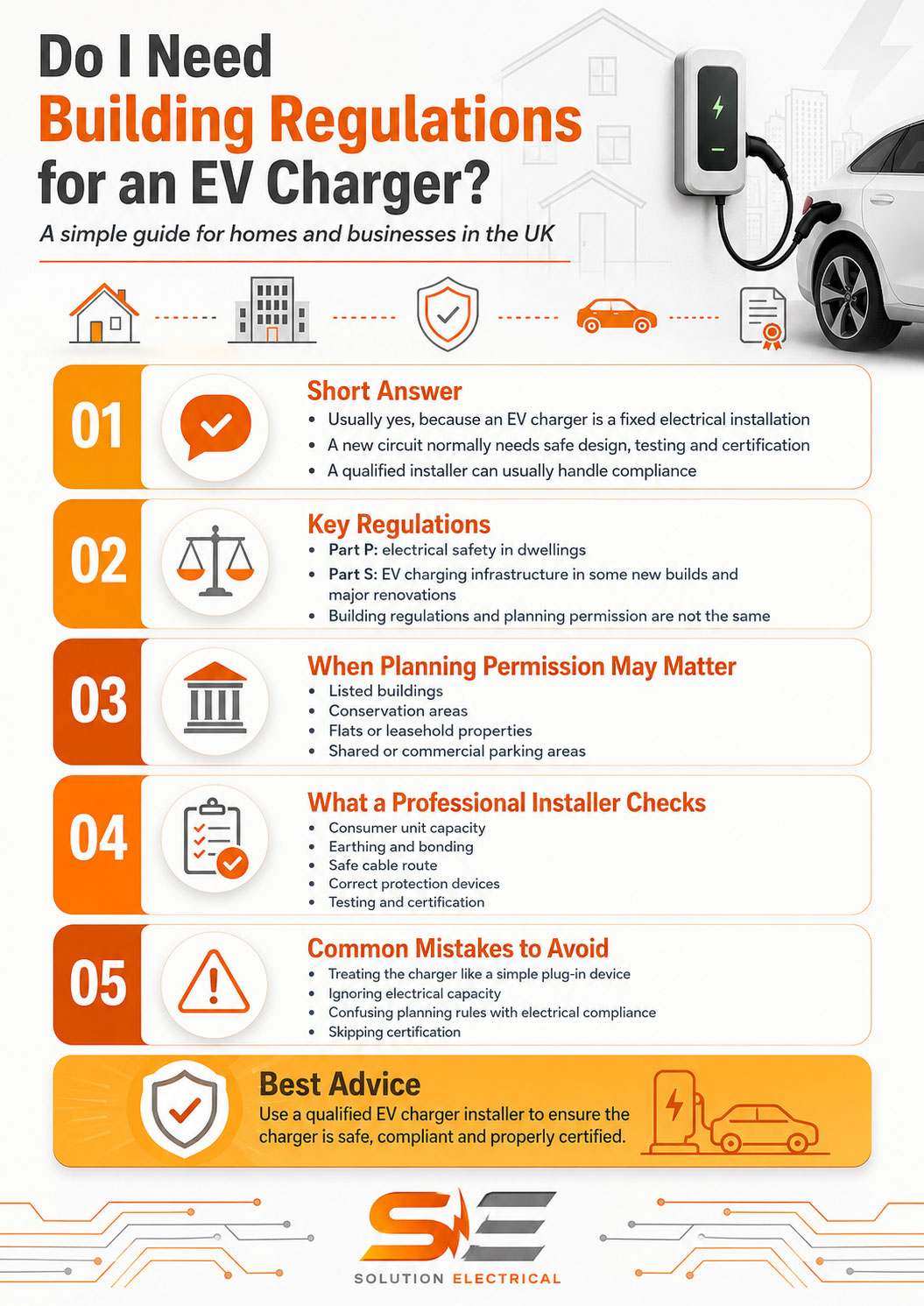
EV Charger Building Regulations Infographic
This quick visual guide summarises the main building regulation points, planning considerations and professional checks involved in a safe EV charger installation.
Do You Need Planning Permission for an EV Charger?
Building regulations and planning permission are different. Building regulations focus on safety, technical standards and compliance. Planning permission focuses on whether development is acceptable in planning terms, including appearance, location and impact on the surrounding area.
For many houses with off-street parking, a wall-mounted EV charger may fall under permitted development rights, which means a full planning application is often not required. However, this depends on the property, the charger position, size, location and any special restrictions affecting the site. Listed buildings, conservation areas, flats, leasehold properties and shared parking arrangements may involve extra considerations.
You should not assume planning permission is never required. A charger positioned in a sensitive location, a freestanding charging unit, a commercial installation or work involving a listed building may need further checks. If there is any doubt, it is wise to ask the local planning authority or seek professional advice before installation.
- Planning permission is separate from building regulations
- Many home chargers may be permitted development
- Listed buildings and conservation areas need extra care
- Flats and leasehold homes may need landlord or freeholder consent
- Commercial chargers may involve wider planning considerations
- Always check before installing in a sensitive or shared location
Home Chargers, Landlords and Business Premises
The compliance route can be different depending on whether the charger is for a private home, a rental property, a block of flats or a business premises. A homeowner with a driveway may mainly need a safe electrical design, notification and certification. A landlord may also need to consider tenant safety, property records and ongoing maintenance responsibilities.
For flats and shared parking areas, the situation can be more complex. Cable routes may pass through communal spaces, the power supply may come from a landlord-controlled area, and permissions may be needed from the freeholder or managing agent. Fire safety, access, metering and billing can also become part of the discussion.
For businesses, EV charging should be planned as part of the wider electrical system. A single charger for a company vehicle may be simple, but multiple chargers for staff, visitors or fleet vehicles may require load management, distribution board upgrades, signage, access control and future expansion planning. A site survey is the best starting point.
What a Competent EV Charger Installer Should Check
A professional installer should not simply fit the charger where it looks convenient. The installation starts with assessment. The electrician should check the property supply, consumer unit or distribution board, main fuse rating, earthing system, cable route, charger location and likely charging demand.
They should also consider whether the charger includes built-in protection or whether additional protection is needed. Modern EV chargers may include smart features, load balancing and safety technology, but the installation must still be designed correctly. The charger must be suitable for the property and installed according to the manufacturer’s instructions and relevant electrical standards.
After installation, testing is essential. The final paperwork should confirm that the work has been inspected and tested. This documentation is useful for building regulations compliance, warranty records, insurance queries and future property sales.
- Property supply capacity and main fuse rating
- Consumer unit condition and available circuit space
- Earthing, bonding and protective arrangements
- Safe cable route from supply to charger
- Weatherproof and accessible charger location
- Final testing, certification and user handover
Common EV Charger Compliance Mistakes
One of the most common mistakes is choosing a charger online before checking whether the property’s electrical system is suitable. A charger may look smart and modern, but it still needs the correct supply, protection and installation conditions. Buying the unit first can sometimes create compatibility or installation issues.
Another mistake is ignoring the route between the consumer unit and the charger. Long cable runs, awkward access, external walls, driveways and detached garages can all affect the installation. A good survey identifies these details before the quote is finalised.
Some people also confuse planning permission with electrical compliance. Even if planning permission is not required, the electrical work must still be safe and properly certified. Others assume that any electrician can install an EV charger without specialist knowledge, but EV charging has specific technical risks that need experience and correct equipment.
- Buying a charger before checking electrical capacity
- Assuming planning permission and building regulations are the same
- Ignoring earthing and protective device requirements
- Installing without proper testing or certification
- Choosing a poor charger location with unsafe cable routing
- Failing to plan for future charging demand
What to Prepare Before Booking an EV Charger Installation
Before booking an installation, gather basic information about your property and vehicle. The installer may ask where your consumer unit is located, where you park, whether the parking space is private, whether you own the property and whether any leasehold or landlord permission is needed.
Photos can be useful, especially of the consumer unit, meter area, driveway or parking space, and the proposed charger location. However, a site visit may still be needed where the installation is complex, where the electrical supply needs checking, or where the cable route is not straightforward.
You should also think about how you want to use the charger. A homeowner charging one vehicle overnight may have different needs from a business with multiple users. Smart charging, app control, solar compatibility, load balancing and future expansion can all influence the best solution.
- Confirm where you normally park the vehicle
- Check whether you own the property or need permission
- Take clear photos of the consumer unit and meter area
- Think about cable route and charger position
- Decide whether smart charging features are important
- Ask what certification you will receive after completion
Final Advice for EV Charger Building Regulations in Barnet
So, do you need building regulations for an EV charger? In most domestic situations, the electrical work must be treated properly because a charger usually involves a new circuit and must be installed safely. You may not need to personally deal with building control if you use a registered competent installer, but you should still expect proper notification, testing and certification.
For new builds, major renovations, commercial projects and developments with parking, Part S may also be relevant. For houses, planning permission may not be needed in many standard cases, but this should not be confused with electrical compliance. The safest approach is to check the property, the parking arrangement and the electrical supply before installation begins.
Whether you are upgrading a driveway charger, preparing a rental property, planning workplace charging or comparing smart charging options, Solution Electric can help with safe electrical assessment, compliant installation and practical advice. For reliable Electrical Services in Barnet and Fast & Smart Charging Solutions For Homes & Businesses Across North London, a professional inspection is the best first step before fitting any EV charging equipment.
Need a Compliant EV Charger Installation in Barnet?
Solution Electric provides professional electrical support for homes, landlords and businesses across Barnet and North London, including EV charger installation, safety checks, consumer unit assessment and electrical certification.
Book a professional EV charger assessment before installation.