If your RCD keeps tripping, it is usually a warning that your electrical system has detected a fault or an unsafe condition. An RCD, or residual current device, is designed to switch off power quickly when it senses electricity leaking away from the circuit. This can help reduce the risk of electric shock and electrical fire, but repeated tripping should never be ignored. If you need reliable Electrical Services in Barnet, a qualified electrician can inspect the problem properly, while Expert Electrical Fault Finding in Barnet can identify whether the issue is caused by an appliance, circuit, moisture, damaged wiring or an overloaded consumer unit.
Many homeowners reset the switch and hope the problem disappears. Sometimes the RCD may trip because of a one-off appliance fault, but if it happens again, there is usually an underlying reason. The fault might be obvious, such as a kettle that trips the power every time it is plugged in. In other cases, the fault can be hidden inside wiring, outdoor lighting, sockets, a shower circuit, an immersion heater or a consumer unit.
This guide explains 10 common reasons why your RCD keeps tripping, what you can safely check yourself, when to stop resetting the switch, and why professional diagnosis is often the safest way to fix the issue properly.
What Does an RCD Do?
An RCD is a protective device that monitors the flow of electricity through a circuit. In normal use, the current flowing out should match the current returning. If the RCD detects an imbalance, it assumes electricity may be leaking to earth and disconnects the supply quickly.
This protection is especially important in homes because leakage current can occur through damaged appliances, wet fittings, faulty cables or accidental contact. The RCD does not trip to annoy you; it trips because something does not look safe. That is why repeated tripping needs careful attention rather than repeated resetting.
Modern consumer units often have one or more RCDs or RCBOs protecting different circuits. If a single circuit trips, the fault may be easier to narrow down. If one main RCD trips and cuts power to multiple circuits, diagnosis can take longer because several areas of the property may need checking.
- An RCD detects electrical leakage
- It disconnects power when an imbalance is found
- It helps reduce electric shock risk
- Repeated tripping suggests an underlying fault
- Older consumer units may make diagnosis harder
- Professional testing can locate the exact cause
10 Common Reasons Why Your RCD Keeps Tripping
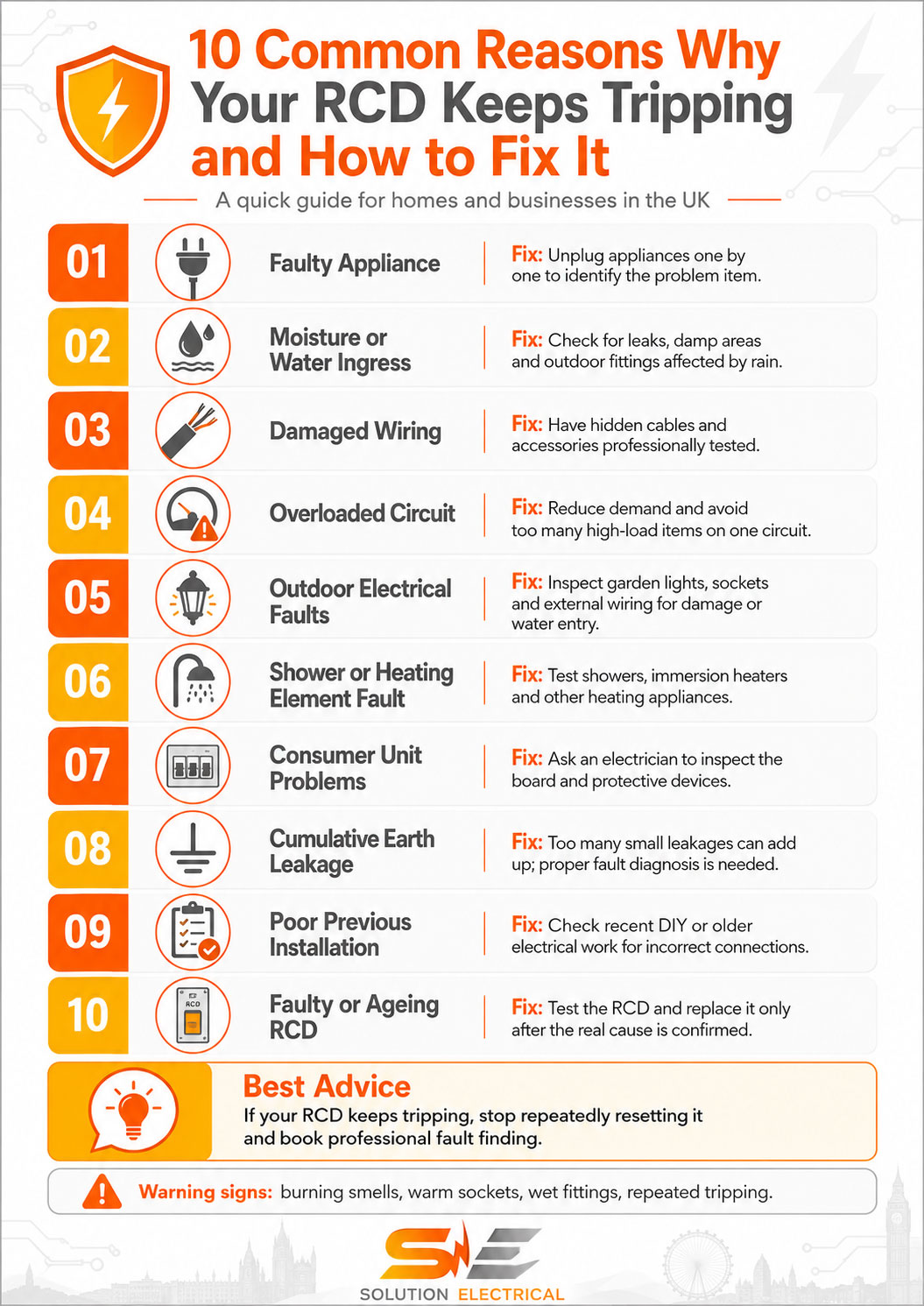
This infographic gives a quick visual summary of the most common causes of RCD tripping, practical warning signs and when professional fault finding is needed.
1. A Faulty Appliance Is Causing the RCD to Trip
One of the most common reasons an RCD keeps tripping is a faulty appliance. Kettles, washing machines, dishwashers, tumble dryers, ovens, fridges, freezers and extension leads can all develop insulation faults or internal damage. When the appliance is switched on, electricity may leak to earth and the RCD trips.
A useful clue is timing. If the RCD trips every time you use one appliance, that appliance may be the cause. However, some faults are intermittent. A washing machine, for example, may only trip during the heating cycle. A fridge may trip occasionally when the compressor starts. A cooker may trip when a specific oven element heats up.
You can sometimes narrow this down by unplugging non-essential appliances and resetting the RCD. Then plug appliances back in one at a time. If one appliance trips the RCD repeatedly, stop using it and have it repaired or replaced. Do not keep resetting the RCD while continuing to use a suspected faulty appliance.
- Kettles and toasters can fail internally
- Washing machines may trip during heating cycles
- Cooker elements can cause earth leakage
- Fridges and freezers may trip intermittently
- Damaged extension leads can also trigger RCDs
- Faulty appliances should be disconnected and checked
2. Moisture or Water Has Entered an Electrical Point
Water and electricity are a dangerous combination. Moisture inside a socket, light fitting, junction box, outdoor switch, extractor fan or appliance can cause the RCD to trip. This is common after leaks, condensation, roof issues, damp walls, bathroom steam or heavy rain affecting external fittings.
Bathrooms, kitchens, utility rooms and outdoor areas are particularly vulnerable because they naturally involve water, steam and humidity. If a circuit trips after rain, the fault may be connected to garden sockets, outdoor lights, security lights, pond pumps or external wiring.
If you suspect water has entered electrics, do not touch wet accessories or try to dismantle fittings. Turn the affected circuit off if it is safe to do so and call an electrician. Moisture-related faults can become more dangerous over time and may need insulation resistance testing to confirm whether the circuit is safe to re-energise.
- Leaks can affect sockets and ceiling lights
- Condensation can damage bathroom fittings
- Rain can enter outdoor lights or junction boxes
- Garden electrics are common sources of tripping
- Wet accessories should not be touched
- Testing is needed before the circuit is trusted again
3. Damaged Wiring or Cable Insulation
Damaged wiring is another serious reason why an RCD may trip. Cable insulation can be damaged by age, heat, rodents, DIY drilling, poor installation, trapped cables, loose accessories or previous building work. When insulation breaks down, current can leak to earth and the RCD responds by switching off the circuit.
This type of fault can be difficult for a homeowner to find because the damage may be hidden behind walls, under floors, in loft spaces or inside accessories. Sometimes the fault only appears when a cable moves, when a load is applied, or when moisture reaches the damaged area.
Signs of wiring problems can include burning smells, discoloured sockets, buzzing sounds, flickering lights, warm accessories or repeated RCD tripping with no obvious appliance cause. Any of these signs should be treated seriously. A professional electrician can use test equipment to check insulation resistance, continuity and earth fault conditions.
- Cables may be damaged by drilling or screws
- Rodents can chew cable insulation
- Loose connections can create heat and faults
- Old wiring may break down over time
- Hidden faults need professional test equipment
- Burning smells or warm sockets require urgent attention
4. The Circuit Is Overloaded
An RCD is not primarily an overload device, but overloaded or stressed circuits can still contribute to tripping, especially where appliances, extension leads or faulty equipment are involved. A circuit supplying too many high-demand appliances may also cause associated breakers to trip or reveal weak points in the wiring.
Common examples include multiple heaters on one circuit, kitchen appliances running together, overloaded extension leads, or office equipment connected through multi-way adaptors. In older properties, the electrical system may not be designed for today’s level of demand.
If tripping happens when several appliances are used at the same time, it may be a load-related issue. However, this should still be checked properly because the true cause may be a faulty appliance, loose connection or circuit limitation rather than simple demand.
| Possible Trigger |
Common Sign |
Recommended Action |
| Faulty appliance |
RCD trips when one item is used |
Unplug the item and arrange repair or replacement |
| Moisture ingress |
Trips after rain, leaks or bathroom steam |
Do not touch wet electrics; call an electrician |
| Damaged wiring |
Tripping continues with appliances unplugged |
Book electrical fault testing |
| Overloaded circuit |
Trips when several items run together |
Reduce load and have the circuit assessed |
| Consumer unit issue |
Unpredictable or repeated tripping |
Have the board and protective devices inspected |
5. Outdoor Lights, Garden Sockets or External Wiring
Outdoor electrical installations are a frequent cause of RCD tripping. External lights, garden sockets, sheds, garages, pond pumps, driveway lights and security lighting are exposed to weather, temperature changes and physical damage. Over time, seals can fail, water can enter fittings, and cables can become damaged.
If your RCD trips after heavy rain or when outdoor lighting comes on, external electrics should be suspected. A poorly sealed outdoor junction box or damaged cable buried in the garden can cause repeated tripping that appears random from inside the house.
Outdoor faults should be checked by a qualified electrician because the risk of electric shock is higher in wet environments. The electrician may disconnect sections, test insulation resistance and inspect fittings to find the exact source of the leakage.
6. A Shower, Immersion Heater or Heating Element Fault
Heating elements are another common cause of RCD problems. Electric showers, immersion heaters, ovens, hobs, tumble dryers and washing machines use elements that can deteriorate over time. As the element breaks down, it may leak current to earth and trip the RCD.
These faults can be intermittent because the appliance may only trip after heating starts. For example, an electric shower may switch on normally but trip after a few seconds. An oven may work on one setting but trip on another. An immersion heater may trip during the heating cycle.
Do not ignore element-related tripping. These appliances draw significant power and should be repaired by a suitable professional. Where the fault is part of the fixed electrical installation, an electrician can test the circuit and confirm whether the appliance or wiring is responsible.
7. Problems Inside the Consumer Unit
Sometimes the problem is not the appliance or the circuit, but the consumer unit itself. Protective devices can age, connections can loosen, circuits may be incorrectly arranged, or older boards may not be suitable for the way the property is now used.
A consumer unit should never be opened by an unqualified person. Inside the board are live parts that can be extremely dangerous. If the RCD trips repeatedly and no obvious appliance fault is found, the consumer unit should be inspected by an electrician.
The electrician may check for loose terminals, damaged protective devices, shared neutral issues, incorrect circuit separation or signs of heat damage. In some cases, a consumer unit upgrade or circuit reconfiguration may be recommended.
8. Nuisance Tripping or Cumulative Earth Leakage
RCDs can sometimes trip because several appliances each produce a small amount of leakage current. Individually, each appliance may be within acceptable limits. Together, the combined leakage can become enough to trip the RCD, especially where many modern electronic devices, chargers, computers and appliances are used on the same protected side of the board.
This is often described as nuisance tripping, but the term can be misleading. The RCD is still responding to an electrical condition. The solution may involve identifying the appliances contributing to leakage, improving circuit separation, replacing faulty equipment or upgrading protection arrangements.
This is where professional Electrical Fault Diagnosis is useful. Proper testing can distinguish between a genuine dangerous fault, appliance leakage, circuit problems and poor consumer unit design.
9. DIY Electrical Work or Poor Previous Installation
Poor-quality electrical work is a common hidden cause of RCD tripping. Incorrect connections, damaged cables, mixed neutrals, poor junction boxes, overloaded spurs and badly installed outdoor supplies can all create faults that may only become obvious later.
Sometimes the issue begins after a new light fitting, socket, kitchen appliance, bathroom fan or garden supply has been added. If the RCD started tripping soon after recent work, the new installation should be checked carefully.
Electrical work should be completed safely, tested and certified where required. If you suspect previous work was not done correctly, do not try to keep using the circuit. Have it inspected before further damage occurs.
10. Faulty RCD or Ageing Protective Device
Although less common than appliance or wiring faults, an RCD itself can become faulty or overly sensitive. Protective devices can age, especially in older consumer units or where there has been heat, mechanical wear or previous electrical stress.
An electrician can test the RCD using specialist equipment to check whether it trips within the required time and current limits. If the device fails testing or behaves unpredictably, replacement may be needed. However, it is important not to assume the RCD is faulty just because it trips often. In most cases, the RCD is doing its job and reacting to a real fault.
Replacing an RCD without finding the cause may leave the original problem unresolved. Proper testing should always come before replacement decisions.
What Can You Safely Check Before Calling an Electrician?
There are a few simple checks you can do safely, but you should never open the consumer unit, remove sockets, dismantle switches or touch wet electrical fittings. Start by noting when the RCD trips. Does it happen when a specific appliance is used? After rain? At night when outdoor lights come on? When the oven, shower or washing machine starts?
You can unplug portable appliances and try resetting the RCD once. If it stays on, plug items back in one at a time. If one appliance trips it again, stop using that item. If the RCD trips even with appliances unplugged, the issue may be with fixed wiring, external electrics or the consumer unit.
Do not keep resetting an RCD repeatedly. Repeated tripping means the system is warning you. Resetting without solving the fault may increase risk and could damage appliances or wiring.
- Write down when the RCD trips
- Unplug portable appliances before resetting once
- Do not touch wet fittings or exposed accessories
- Stop using any appliance that trips the RCD
- Check whether rain or outdoor lights are involved
- Call an electrician if the fault repeats
When Should You Call an Electrician?
You should call an electrician if the RCD trips repeatedly, if it trips with appliances unplugged, if it happens after rain, if there are signs of heat or burning, or if part of your home has no power. You should also get professional help if the fault affects fixed wiring, bathroom electrics, outdoor circuits, a shower, an immersion heater, a cooker circuit or the consumer unit.
If your RCD keeps tripping, Solution Electric can help identify the cause safely and carry out the right repair. From hidden wiring faults and damaged accessories to appliance-related issues and consumer unit concerns, our team provides Expert Electrical Repairs in Barnet and trusted Electrical Services in Barnet for homes and businesses across the local area.
Need Help with an RCD That Keeps Tripping?
Solution Electric provides professional electrical fault finding, RCD testing, consumer unit checks and electrical repairs for homes, landlords and businesses across Barnet and North London.
Book expert electrical fault diagnosis today.